The cheapest Rolex, and the most expensive colour
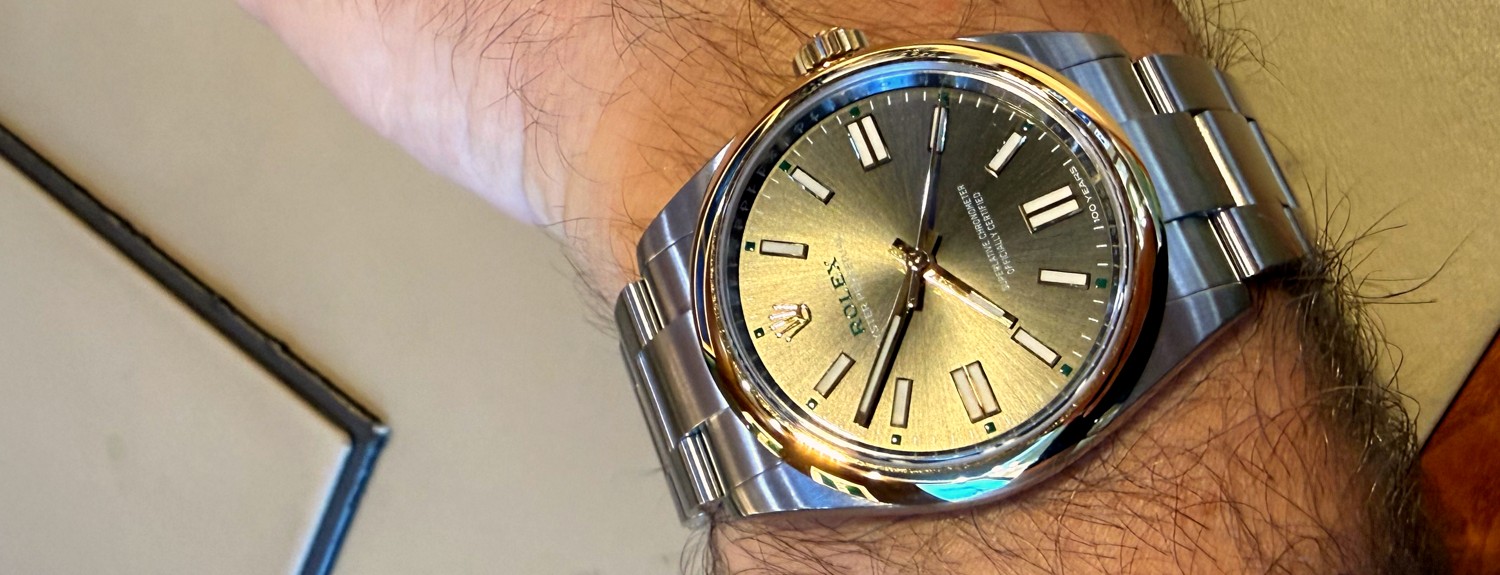
The watch in the photograph is the one the boutique handed me: the Oyster Perpetual 41 Rolex built for the Oyster case’s hundredth birthday, ref. 134303, a yellow-gold bezel and crown on an otherwise steel watch, “100 Years” printed where Swiss Made usually sits. I tried it on, turned my wrist under the lights, and gave it back. Under the birthday gold sits the most ordinary watch Rolex makes: no date, no complication, a time-only dial. That ordinariness is what I want to talk about.
There is another Oyster Perpetual 41 that is mechanically identical to this one. Same Oystersteel case. Same calibre 3230. Same bracelet, same everything that costs money to build. A few years ago it was changing hands for the price of a small car. The only thing separating that watch from the plain one is the colour of a thin layer of lacquer on the dial.
That watch is the turquoise one. You will hear people call it the “Tiffany.” Rolex never did; it called the colour turquoise blue and left it at that. The nickname did the rest, and the nickname is most of the story.
How a sensible watch lost its mind
In September 2020 Rolex gave the Oyster Perpetual five lacquered dials in candy colours: turquoise, coral red, yellow, green, candy pink. It was a deliberate echo of the “Stella” dials it made in the disco years. For a line that had spent a decade being the watch you bought your nephew for graduation, this was a jolt. The watches were cheap by Rolex standards. The 41mm turquoise retailed around six thousand dollars. Then something happened that had nothing to do with Rolex at all.
Patek Philippe released a Nautilus with a dial in the robin’s-egg blue of a Tiffany box, made with the jeweller, in a run of 170 pieces. One of them went to auction in December 2021 and sold for six and a half million dollars. Overnight that exact shade of blue became the most wanted colour in the watch world, and the only version most people could conceivably reach was sitting on the dial of an entry-level Rolex.
So they reached. Waitlists for the turquoise were already past two years by 2021. On the secondary market it came unglued from anything resembling sense. By the spring of 2022 it was the watch every dealer wanted to be seen with and almost none could supply.
How high it actually went depends on who you ask, and the honest answer is that the sources disagree. At Christie’s in Geneva in May 2022 a near-new turquoise 41 hammered for close to seventy thousand dollars, against that six-thousand retail. Asking prices on Chrono24 were sillier still; one sat at eighty-nine thousand euros, which tells you more about the seller’s optimism than about the market. A coral-red example at the same Christie’s sale made around fifty thousand. Pick whichever number you like. The shape of it is the same. A steel watch with no date was trading at five, eight, ten times what Rolex charged for it, and the thing carrying all that value was the paint.
What the market was actually pricing
When the broader watch bubble burst, and it burst hard, the ordinary Oyster Perpetuals came back to earth with it. The whole market peaked in spring 2022 and then fell for thirteen straight quarters; the Patek Nautilus 5711 roughly halved, from two hundred thousand dollars to one hundred. A black or silver 124300 drifted back toward retail, give or take. The hype drained out of them exactly as you would expect.
The turquoise did not. It gave back a lot of the madness, but it never came home. Years after the peak it still trades at a heavy premium over the watches it is otherwise identical to. Same case. Same movement. A completely different conversation.
The usual lesson people take from this is “Rolex only goes up,” which is simply false. Most of these dials proved it false. What was really going on is that the market was never pricing the watch. It was pricing the colour, the scarcity, and the story stapled to them. Strip those away and you have the ordinary one: the same object, beautifully made, worth roughly what you paid. Add them back and you have a collectible that happens to be wearing an Oyster Perpetual as a delivery vehicle.
I find that clarifying rather than depressing. Given the choice, the ordinary one is the watch to buy, and to buy on purpose. It does everything the turquoise does, keeps the same time to the same standard, and it owes nobody a return. The turquoise is a lovely watch and a genuinely scarce one. If you want it for what it is, buy it with your eyes open. Just don’t mistake the premium for the watch. The premium is for the paint, and the paint is the one part of the whole thing that has nothing to do with watchmaking.